
By Satish Dodia | Meta Ads Specialist | ChatGPT Ads Specialist | Performance Marketer
Last Updated: September 2026
Meta Ads have been part of my performance marketing work for years.
Facebook and Instagram changed the way businesses could reach people without waiting for them to search for a product or service.
But something different is happening now.
People are increasingly using AI assistants to ask questions, compare solutions, research companies and understand what they should do next.
That creates a new advertising environment.
Meta Ads are built around social discovery.
ChatGPT Ads are built around a conversational environment.
For marketers, this isn’t simply another platform comparison.
The real question is:
What happens when people discover a business while scrolling through social media versus when they are actively explaining a problem to an AI assistant?
I’m Satish Dodia, a performance marketer with 10+ years of experience in Google Ads, Meta Ads, SEO, lead generation and growth marketing.
I’ve worked with businesses across different industries and markets, and I’m now also focusing on ChatGPT Ads, AI advertising and conversational marketing.
In this article, I’ll explain the practical difference between Meta Ads and ChatGPT Ads, where each fits into a marketing strategy, and how I would approach them for an IT company looking to generate qualified enquiries.
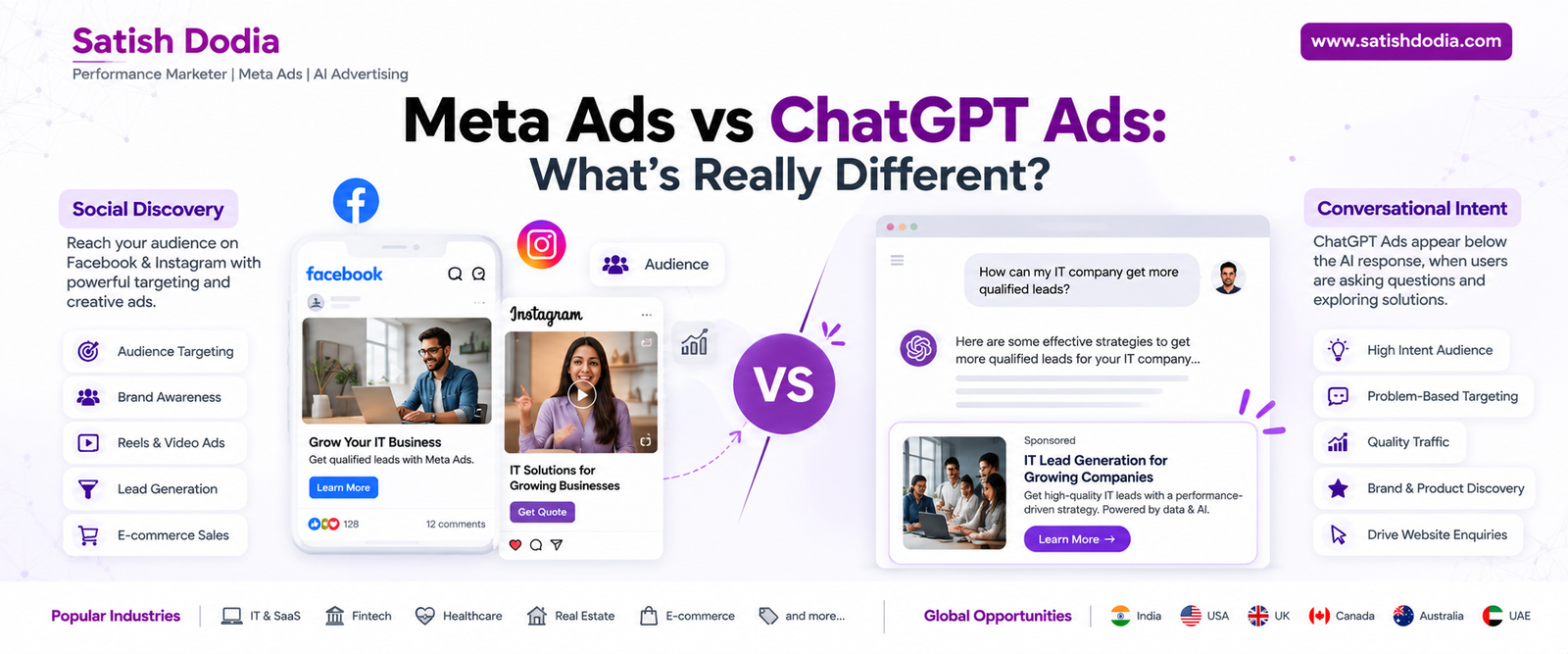
Meta Ads vs ChatGPT Ads: The Simple Difference
If I had to explain the difference in one sentence:
Meta Ads help businesses reach people while they are discovering and consuming content.
ChatGPT Ads can reach people within a conversation where they are researching a problem, comparing options or exploring a solution.
That difference changes the way we think about targeting, creative, messaging and lead generation.
How Meta Ads Work
Meta Ads are primarily associated with advertising across platforms such as Facebook and Instagram.
A business can use different campaign objectives, creative formats, audiences and placements depending on its marketing goal.
For example, an IT company might create a campaign around:
“Need a custom CRM for your growing business?”
The advertisement could appear while a business owner is:
• Watching a Reel
• Scrolling Facebook
• Looking through Instagram
• Engaging with business content
• Browsing other content across eligible Meta placements
The person may not have been searching for CRM software at that exact moment.
The advertisement introduces the possibility.
That’s one of the interesting characteristics of social advertising.
Meta Ads can create demand.
The user may not wake up thinking:
“I need a software development company today.”
But a well-positioned advertisement can make them think:
“Actually, we have this problem too.”
That’s where good creative becomes extremely important.
Meta itself emphasizes creative designed for placements such as Reels, along with audience, delivery and measurement capabilities within its advertising ecosystem.
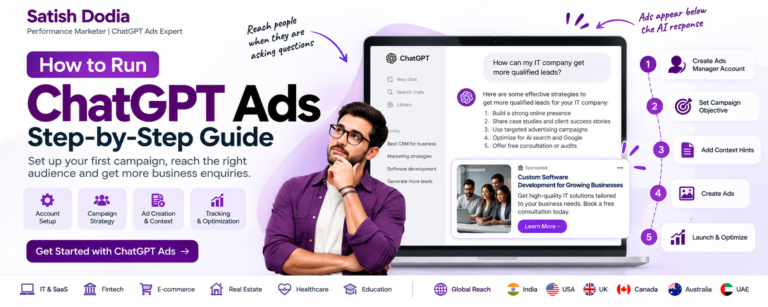
How ChatGPT Ads Work
ChatGPT Ads operate in a different environment.
Instead of appearing while someone is casually scrolling through social content, an advertisement can appear below a ChatGPT response when there is a relevant match.
OpenAI describes ChatGPT Ads as an advertising environment designed to reach users while they explore, compare and make decisions within a conversation.
For example, someone might ask:
“We are a 50-person company and our internal software is becoming difficult to maintain. Should we build a custom application or buy SaaS software?”
That’s a very different signal from:
“software development company”
The user has already explained:
• The business situation
• The problem
• The decision they are facing
• The potential solution
• Their requirements
This is what makes conversational advertising interesting.
The Biggest Difference: Social Discovery vs Conversational Discovery
This is the part I believe marketers need to understand.
Meta Ads
The user is often consuming content.
Scroll → See Ad → Get Interested → Click → Explore → Enquire
ChatGPT Ads
The user is actively asking or researching.
Question → Conversation → Explore Options → Relevant Ad → Click → Explore → Enquire
Neither journey is identical.
And that means the advertising strategy shouldn’t be identical either.
Meta Ads Can Interrupt the Scroll
Imagine you’re an IT company offering custom software development.
Your Meta ad could say:
“Your Business Has Outgrown Spreadsheets.”
Then show:
A business dashboard → CRM → automation → analytics → CTA.
The user might stop because the problem feels familiar.
The advertisement has created a connection between the user’s current situation and your service.
This is why Meta creative matters so much.
The first few seconds, headline, visual, offer and message all have to work together.
ChatGPT Ads Can Enter the Problem-Solving Moment
Now imagine the same IT company.
A potential customer asks ChatGPT:
“How can I automate our sales process? We’re currently using Excel, WhatsApp and several disconnected tools.”
ChatGPT answers the question.
A relevant advertisement may appear below the response.
That advertisement could say:
Custom Business Software for Growing Teams
Replace disconnected tools with software designed around your actual workflow.
The context is different.
The person isn’t simply browsing.
They’re trying to solve something.
OpenAI says ad selection can consider signals including the current conversation’s context and intent, the landing page, ad title and copy, advertiser-provided context hints and, where applicable, selected signals from the broader ChatGPT experience.
This Changes How We Think About Targeting
With Meta Ads, marketers often think about:
Who is the audience?
For example:
• Business owners
• Founders
• Marketing managers
• IT managers
• E-commerce owners
• SaaS companies
• People interested in technology
With ChatGPT Ads, another question becomes important:
What problem is this person trying to solve?
For example:
• Looking for custom software
• Comparing CRM options
• Planning an ERP implementation
• Trying to automate business processes
• Looking for an app development company
• Considering outsourcing software development
• Trying to modernize an old application
OpenAI’s current guidance describes context hints as information about what a business offers, who it helps and when the offering may be useful. These hints help guide relevance but are not traditional exact-match keywords or guaranteed delivery rules.
Meta Ads vs ChatGPT Ads: A Practical Comparison
Meta Ads
Environment: Social platforms
Primary behaviour: Browsing and content discovery
Important elements: Creative, audience, offer, placement and landing page
Typical creative: Images, videos, Reels, carousels and other social formats
Discovery model: Audience and content-driven
Marketing opportunity: Awareness, demand generation, consideration and conversion
ChatGPT Ads
Environment: Conversational AI
Primary behaviour: Asking, researching and comparing
Important elements: Context, intent, ad relevance, copy and landing page
Creative: Advertisement copy and supported image creative
Discovery model: Conversational relevance
Marketing opportunity: Problem discovery, solution exploration, consideration and conversion
ChatGPT Ads currently support campaign approaches including CPM, CPC and conversion-optimized CPC objectives, with campaign structure built around campaigns, ad groups and ads.
What About Lead Generation?
This is where the comparison gets much more interesting for me as a performance marketer.
Let’s take an IT company.
The company provides:
• Custom software development
• Mobile app development
• Web application development
• CRM development
• ERP solutions
• AI integration
• Cloud solutions
Its traditional Meta campaign could look like this:
Campaign: Generate IT enquiries
Audience: Business owners, founders, decision-makers
Creative: Short video showing business problems and software solutions
CTA: Get a Consultation
The company then measures:
Reach → Clicks → Landing Page → Form → Sales Call
That’s a familiar performance marketing funnel.
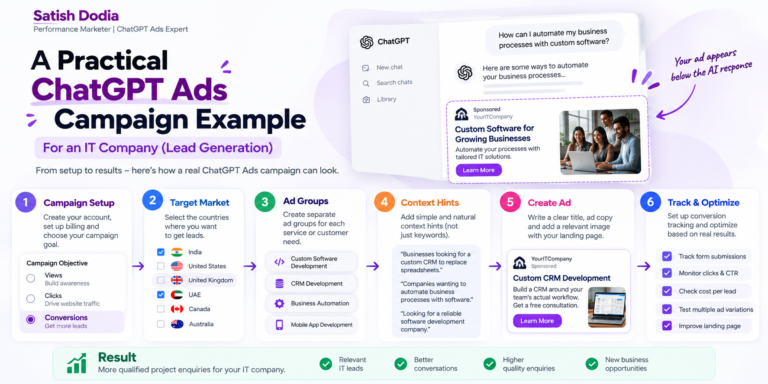
Small IT Lead Generation Case Study
Example Scenario
Let’s consider a hypothetical IT company targeting businesses in India, the UAE and the UK.
The company has good technical capabilities but receives most of its new projects through referrals.
The problem:
They need a more consistent source of enquiries.
Meta Ads Strategy
Instead of advertising:
“We Build Websites and Apps”
I would test a problem-focused message:
“Still Managing Your Business With 5 Different Tools?”
Supporting copy:
CRM, WhatsApp, spreadsheets, accounting software and internal processes don’t always work together. We help businesses build custom software around the way they actually operate.
CTA:
Discuss Your Project
This gives the user a reason to stop.
Then I Would Test the Same Business on ChatGPT Ads
Instead of using exactly the same message, I would think about the conversations that could indicate genuine demand.
For example:
“Should I build custom software or use SaaS?”
“How much does custom CRM development cost?”
“How can I automate my company’s manual processes?”
“What should I consider before hiring a software development company?”
“How do I replace spreadsheets with a business management system?”
These aren’t simply keywords.
They’re questions connected to buying decisions.
The ChatGPT ad and landing page should then answer the user’s next logical question.
OpenAI recommends clear, specific, benefit-focused advertising and encourages multiple distinct ad variations rather than repeating the same message.
The Landing Page Becomes Even More Important
One mistake I see regularly in paid advertising is sending every campaign to the homepage.
For ChatGPT Ads, I would be particularly careful about this.
If the ad is about:
Custom CRM Development
Don’t send the user to:
Home → Services → Software → CRM → Contact
Create a focused page:
Custom CRM Development for Growing Businesses
Then explain:
• What problem you solve
• Who the service is for
• What you build
• Typical project process
• Technology capabilities
• Integrations
• Security
• Case studies
• FAQs
• Project enquiry form
OpenAI’s current advertising guidance also recommends using the most relevant landing page rather than defaulting every advertisement to a generic homepage.
Meta Ads vs ChatGPT Ads for Different Industries
The same difference can apply across many industries.
IT & SaaS
Meta Ads:
Create awareness around the problem.
ChatGPT Ads:
Reach conversations around software selection, automation and technology decisions.
Fintech
Meta Ads:
Explain the product and create interest.
ChatGPT Ads:
Potentially reach conversations around financial software, payment systems, accounting automation and business finance tools.
E-commerce
Meta Ads:
Product discovery, visual storytelling and retargeting.
ChatGPT Ads:
Potential relevance when users are researching products, comparing options or trying to decide what to buy.
Healthcare
Marketing needs to be handled carefully because healthcare advertising involves additional privacy, regulatory and platform considerations.
The strategy may focus on legitimate service discovery and educational information rather than making sensitive personal assumptions about users.
Real Estate
Meta Ads:
Property discovery, visual creatives, location-based campaigns and enquiries.
ChatGPT Ads:
Potential relevance around questions such as property research, home-buying considerations, renovation decisions and related services, subject to advertising policies and market availability.
Education
Meta Ads:
Course discovery, video content and student acquisition.
ChatGPT Ads:
Potential relevance around questions about courses, skills, certifications and career development.
Countries Where This Strategy Can Be Interesting
The underlying marketing concept isn’t limited to India.
Businesses operating in markets such as:
India
United States
United Kingdom
Canada
Australia
UAE
Singapore
can evaluate these channels according to their own audience, campaign availability, language, offer and economics.
However, ChatGPT Ads availability is market-dependent and continues to evolve, so advertisers should check the current Ads Manager availability for the specific country before planning a campaign.
What About Industries Like IT, SaaS and Fintech?
These are particularly interesting areas to watch because their customers frequently research before making a purchase.
For example:
A potential SaaS buyer might ask:
“What CRM should a 20-person sales team use?”
A fintech buyer might ask:
“How can my business automate payment reconciliation?”
An IT decision-maker might ask:
“Should we build our own ERP or use an existing platform?”
An e-commerce company might ask:
“Which platform should I use to scale my online store?”
The conversation itself contains information about the problem.
That’s very different from simply knowing that someone clicked an advertisement.
Don’t Treat ChatGPT Ads Like Another Meta Campaign
This is probably the biggest lesson I’d give a marketer.
Don’t take your existing Meta campaign and simply copy:
Headline
Primary Text
Creative
Audience
into ChatGPT Ads.
Start again.
Ask:
What problem does my customer talk about?
Then:
What question might they ask before buying?
Then:
What would make my product genuinely useful in that moment?
Then:
What landing page would naturally continue the conversation?
That’s a much better starting point.
AI Search Visibility Is a Different Conversation
There is another topic marketers are now asking me about:
“How do I get my business mentioned by ChatGPT, Gemini or other AI systems?”
This is different from ChatGPT Ads.
Paid advertising is one thing.
AI search visibility is another.
If someone asks an AI assistant:
“What are some good software development companies in India?”
you cannot simply assume that buying ChatGPT Ads will make your company appear in the organic answer.
Advertising and organic AI visibility should be treated as separate strategies.
For AI search visibility, I would focus on:
• Clear company information
• Strong service pages
• Helpful expert content
• Original case studies
• Author credibility
• Consistent business information
• Technical SEO
• Structured content
• First-hand experience
• Relevant third-party references
• Strong topical coverage
• Content that directly answers real customer questions
This is why I’m not interested in publishing hundreds of generic “AI-written” articles.
The goal should be to create useful content that demonstrates actual experience.
What Does This Mean for SEO in the AI Era?
Traditional SEO is still important.
But the content strategy needs to evolve.
Instead of writing:
“10 Benefits of Digital Marketing”
for the 500th time, create content around real questions your customers ask.
For example:
How Much Does Custom CRM Development Cost in 2026?
Should a Small Business Build or Buy CRM Software?
Google Ads vs Meta Ads for SaaS Companies
How Can an IT Company Generate B2B Leads?
What Should You Ask Before Hiring a Software Development Company?
How Does AI Search Change B2B Lead Generation?
These topics can serve multiple purposes:
Google Search
AI Search
ChatGPT conversations
Sales conversations
Email marketing
One useful article can become an asset across the entire marketing system.
Meta Ads + ChatGPT Ads + SEO: A Different Marketing Funnel
I don’t think businesses should look at these channels in isolation.
A modern B2B marketing system could look like:
SEO
↓
People discover your expertise.
Meta Ads
↓
People discover your brand and problem-solving content.
Google Ads
↓
People actively searching for your service find you.
ChatGPT Ads
↓
Relevant conversations can create another paid discovery opportunity.
Landing Page
↓
Visitor understands your solution.
Lead / Enquiry
↓
Sales process begins.
That’s a much more complete performance marketing ecosystem.
How I Would Structure an IT Company’s Campaign
If an IT company came to me tomorrow and said:
“Satish, we need more qualified B2B enquiries.”
I wouldn’t immediately say:
“Let’s spend more on Meta.”
I’d first understand:
• Which services have the highest margins?
• Which industries are most profitable?
• Which countries are worth targeting?
• What project size qualifies as a good enquiry?
• What questions do prospects ask before contacting you?
• What existing traffic converts?
• Which landing pages work?
• What happens after someone submits an enquiry?
• How quickly does the sales team respond?
Then I would build the advertising strategy around the answers.
That is performance marketing.
The platform is only one part of the system.
Meta Ads Specialist + ChatGPT Ads Specialist
My approach to advertising is changing with the platforms.
I’ve worked extensively with Meta Ads, Google Ads, SEO, lead generation and performance marketing, and I’m now extending that experience into ChatGPT Ads and AI advertising.
My focus is not simply:
“Run an ad.”
It is:
Right audience + right problem + right message + right landing page + right measurement.
For Meta Ads, that can mean creative-led social discovery.
For Google Ads, that can mean capturing active search demand.
For ChatGPT Ads, it means understanding conversational intent and building advertising around genuine customer problems.
What Should Businesses Do Next?
If you’re already running Meta Ads, don’t necessarily stop them.
Instead, look at your existing customer journey.
Ask:
Where does my customer discover me?
Where do they research me?
What questions do they ask?
What happens before they submit an enquiry?
Which part of that journey am I currently missing?
That will tell you much more than simply asking:
“Which platform is better?”
Final Thoughts
Meta Ads and ChatGPT Ads are built around different user experiences.
Meta Ads:
People are browsing, discovering and consuming content.
ChatGPT Ads:
People are asking, researching, comparing and exploring solutions within a conversation.
That difference changes how marketers should think about advertising.
For Meta, strong creative and audience strategy remain important.
For ChatGPT Ads, relevance to the conversation, clear benefit-focused messaging, context and a highly relevant landing page become particularly important. OpenAI’s current guidance specifically recommends clear, useful ad copy, distinct variations, relevant landing pages and focused context hints.
And beyond paid advertising, businesses should also start thinking about AI search visibility.
Because the next customer may not search:
“best IT company near me.”
They may simply ask:
“Which IT companies can help me build a custom CRM for my business?”
That’s a different search behaviour.
And marketers need to be ready for it.
About Satish Dodia
Satish Dodia is a performance marketer and growth marketing professional with 10+ years of experience in digital marketing, paid advertising, SEO, lead generation and business growth.
His areas of expertise include:
Meta Ads
Google Ads
ChatGPT Ads
AI Advertising
Performance Marketing
Lead Generation
SEO
AI Search Visibility
Conversational Marketing
Growth Marketing
Conversion Optimization
Satish works with businesses looking to build measurable acquisition systems across paid media, search and emerging AI-driven discovery channels.
For businesses exploring Meta Ads, ChatGPT Ads, AI advertising or B2B lead generation, Satish can help develop the strategy, campaign structure, creative direction, landing-page approach and measurement framework.
WhatsApp: +91 97374 59777
Website: www.satishdodia.com
Frequently Asked Questions
What is the difference between Meta Ads and ChatGPT Ads?
Meta Ads primarily operate across a social advertising environment where businesses can use creative, audience and placement strategies to reach people. ChatGPT Ads operate within a conversational environment where ad relevance can consider the context and intent of the current conversation.
Are ChatGPT Ads the same as Facebook Ads?
No.
They operate in different environments and require different approaches to creative, targeting/context and messaging.
Can I run Meta Ads and ChatGPT Ads together?
Yes, where both platforms and relevant advertising products are available to your business. They can be treated as different parts of a broader acquisition strategy rather than identical channels.
Are ChatGPT Ads keyword-based like Google Ads?
Not in the traditional Search Ads sense.
OpenAI says advertisers can provide context hints describing conversations, topics or keywords where their offering may be relevant, but these hints aren’t exact-match keywords and don’t guarantee delivery for specific conversations.
Where do ChatGPT Ads appear?
OpenAI currently says ads can appear below the end of a ChatGPT response and are clearly labelled as sponsored.
Can ChatGPT Ads generate IT leads?
They can be tested as part of an IT lead-generation strategy where the service is relevant to the conversations being targeted and the campaign is available in the intended market.
The actual result will depend on factors such as offer, relevance, landing page, bidding, creative, market, competition and conversion process.
Does running ChatGPT Ads make my website rank in ChatGPT?
No.
Paid advertising and organic AI search visibility are separate concepts.
Advertising should not be presented as a guarantee that ChatGPT, Gemini or another AI system will recommend a business organically.
How can I improve my AI search visibility?
Start with useful, original and trustworthy content that answers real customer questions.
Build strong service pages, demonstrate first-hand experience, publish case studies, maintain technical SEO and make your company and author information clear and consistent.
There is no guaranteed method for making ChatGPT, Gemini or another AI system rank a particular website.
Contact Satish Dodia
Satish Dodia
Meta Ads Specialist | ChatGPT Ads Specialist | Performance Marketer | AI Advertising
10+ Years of Digital Marketing Experience
WhatsApp: +91 97374 59777
Website: www.satishdodia.com
Looking for Meta Ads, ChatGPT Ads, AI advertising or B2B lead generation strategy?
Let’s discuss your business and build a measurable acquisition strategy.