
By Satish Dodia | Performance Marketing & AI Advertising Specialist
Google Ads has dominated performance marketing for years.
But the way people discover information online is changing.
People don’t always type a short keyword into Google anymore. Increasingly, they ask detailed questions, explain their problems and compare solutions through AI assistants.
That creates a new advertising environment: ChatGPT Ads.
So how are ChatGPT Ads different from Google Ads?
And more importantly, what should marketers understand before adding ChatGPT Ads to their advertising strategy?
I’m Satish Dodia, a performance marketer with 10+ years of experience in digital marketing, paid advertising, SEO and growth marketing. In this article, I’ll break down the practical differences between Google Ads and ChatGPT Ads, including targeting, user intent, campaign structure, advertising formats and measurement.
Google Ads vs ChatGPT Ads at a Glance
| Feature | Google Ads | ChatGPT Ads |
|---|---|---|
| Primary environment | Google Search and Google advertising inventory | ChatGPT |
| User behaviour | Search for information, products or services | Ask questions, research and compare |
| Core signal | Search query, keywords and other campaign signals | Conversation context, intent and advertising signals |
| Keyword targeting | Central to Search campaigns | Context hints can guide relevance but aren’t exact-match keywords |
| Advertising objective | Sales, leads, traffic and other objectives | Views, clicks and conversions, depending on current availability |
| CPC | Yes | Yes |
| CPM | Yes | Yes |
| Landing page | Important | Important |
| Conversion tracking | Supported | Supported for eligible conversion campaigns |
| Main opportunity | Capture existing search demand | Reach relevant conversations and problem-solving moments |
Google Search campaigns are designed to connect advertisements with relevant searches, with keywords playing an important role in Search campaigns.
ChatGPT Ads operate in a conversational environment where advertising relevance can take the context and intent of the conversation into account.
What Is Google Ads?
Google Ads is Google’s advertising platform.
For Search campaigns, advertisers can select keywords that help determine which searches their ads may be eligible to appear against.
For example, an interior design company might target searches such as:
• interior designer near me
• Best google ads management agency
• modular kitchen designer
• interior design company
• best interior designer
Google provides different keyword match types, including broad match, phrase match and exact match, giving advertisers different levels of control over how searches can match their keywords.
The basic journey looks like this:
Search → Keyword Matching → Ad Auction → Advertisement → Website → Conversion
This is particularly useful when someone already has a specific requirement.
What Are ChatGPT Ads?
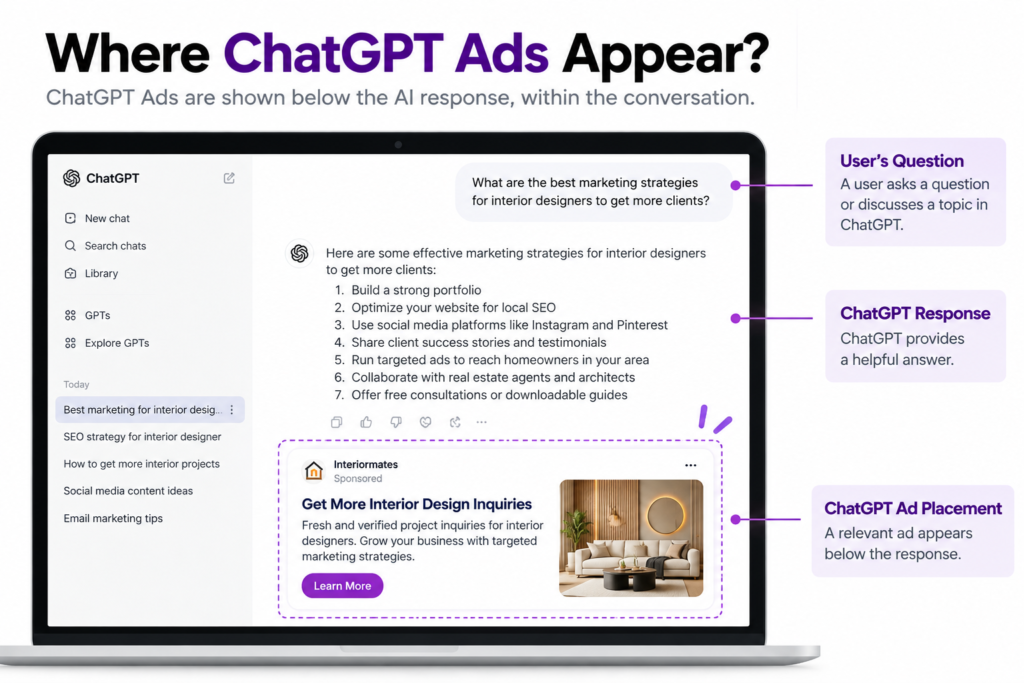
ChatGPT Ads are paid advertisements displayed within the ChatGPT experience.
Depending on the current advertising setup, an advertisement can include elements such as:
• Advertiser name
• Logo or favicon
• Headline
• Description
• Landing page
• Image creative
The important difference is the environment in which the advertisement appears.
A user isn’t necessarily typing:
“best CRM software”
They might instead ask:
“I’m running a small business and need a CRM that my sales team can start using without a complicated setup. What should I look for?”
That’s a much richer expression of intent.
OpenAI describes ChatGPT advertising as operating within a conversational environment where signals such as conversation context and intent can be considered when determining ad relevance.
The Biggest Difference: Search Intent vs Conversational Intent
This is where marketers need to change their thinking.
Google Ads
A user might search:
“SEO agency for SaaS”
The advertiser can build a Search campaign around relevant keyword themes.
Google’s keyword system determines whether an advertisement can match the search, taking into account the keyword and its match type among other signals.
ChatGPT Ads
A user might say:
“I’m launching a SaaS product. What marketing channels should I use to get my first 100 customers?”
The user hasn’t necessarily entered a traditional commercial keyword.
Instead, they are explaining a business problem.
That difference is important for performance marketers.
The opportunity with ChatGPT advertising is not simply to take a Google keyword list and paste it into another platform.
The marketer needs to understand what people are asking, what problems they’re describing and when their product becomes relevant to that conversation.
Google Ads Uses Keywords. ChatGPT Ads Use Context Signals.
Google Ads uses keyword matching heavily within Search campaigns.
Google provides exact, phrase and broad match options that give advertisers different levels of control over how closely keywords need to relate to users’ searches.
ChatGPT Ads work differently.
Advertisers can provide context hints describing conversations, topics or keywords where their product or service may be relevant.
However, these context hints should not be treated as traditional exact-match keywords or guaranteed triggers.
That’s a significant distinction.
Google mindset:
“Which keyword should trigger my ad?”
ChatGPT mindset:
“In which conversations could my solution genuinely be relevant?”
Example: Interior Design Marketing
Let’s take a real marketing example.
Suppose an interior marketing company wants to acquire interior designers as customers.
Google Ads Approach
The advertiser could target searches such as:
interior design marketing agency
marketing for interior designers
lead generation for interior designers
digital marketing for interior designers
The campaign can be structured around keyword themes and Search Ads.
ChatGPT Ads Approach
Instead of focusing only on keywords, the advertiser could think about conversations such as:
“How can I get more interior design projects?”
“Why am I getting website traffic but no enquiries?”
“How can an interior designer generate clients without depending only on referrals?”
“What marketing strategies work for interior designers?”
These are problem-oriented conversations.
The advertiser can then develop relevant context hints, messaging and landing-page content around those themes.
ChatGPT Ads Are Not Simply “Google Ads for AI”
This is one of the biggest mistakes marketers could make.
A Google Search ad might be built around:
Interior Design Marketing Agency
A ChatGPT ad could instead focus on:
Getting More Interior Design Enquiries?
The second message is based around the user’s potential problem rather than simply naming a service.
That doesn’t mean one approach is universally better.
It means the advertising environment is different.
Google Ads vs ChatGPT Ads: User Journey
Need → Search → Compare Ads → Click → Website → Conversion
For example:
“best CRM for small business”
ChatGPT
Problem → Conversation → Research → Explore Solutions → Relevant Ad → Website
For example:
“What should I look for when choosing a CRM for a five-person sales team?”
The distinction matters because the creative strategy should match the environment.
How ChatGPT Ads Can Be Used
ChatGPT Ads can support different advertising objectives depending on the campaign configuration and current platform availability.
Brand Awareness
A business may want more visibility around a new product or service.
Website Traffic
A business may want users to visit its website.
Lead Generation
A business may want potential customers to visit a landing page and submit an enquiry.
Product Discovery
A SaaS company could use advertising to introduce its solution to people discussing a relevant problem.
What Makes a Good ChatGPT Ad?
A strong ChatGPT advertisement should be:
Relevant
It should make sense in the context where it appears.
Specific
Avoid generic advertising language.
Instead of:
We Provide Digital Marketing Services
Try:
Need More Interior Design Enquiries?
Problem-Focused
Connect the message to something the potential customer is trying to solve.
Clear
The user should understand what happens after clicking.
Consistent
Your ad, landing page and actual offer should tell the same story.
Don’t Copy Your Facebook or Google Ad Directly
This is another important point for advertisers.
A Meta ad often needs to compete with a user’s scrolling behaviour.
A Google Search ad needs to align with a search query.
A ChatGPT ad needs to make sense within a conversational environment.
Therefore, the same campaign may require different messaging for each platform.
Interior Design Marketing Agency in Ahmedabad
Meta
Interior Designers: Tired of Depending Only on Referrals?
ChatGPT
Looking for More Interior Design Enquiries?
The underlying offer can be the same.
The message and context can change.
Google Ads vs ChatGPT Ads: What Should Marketers Measure?
Don’t judge a campaign only by clicks.
A performance marketer should follow the complete funnel.
Impressions
↓
Clicks
↓
Landing Page Visits
↓
Enquiries
↓
Qualified Enquiries
↓
Sales
↓
Customer Acquisition Cost
The important question isn’t simply:
“How many people clicked?”
It’s:
“Did the advertising generate commercially valuable actions?”
Why I’m Watching ChatGPT Ads Closely
As a performance marketer, I have spent years working with platforms such as Google Ads, Meta Ads, SEO and conversion-focused digital marketing.
The emergence of conversational advertising creates a new area worth understanding.
The biggest shift isn’t simply another advertising platform.
It’s the change from:
searching for a keyword
to
explaining a problem.
That’s why marketers should learn how conversational intent works before treating ChatGPT Ads as another version of traditional PPC.
About Satish Dodia
Satish Dodia is a performance marketer and growth marketing professional with 10+ years of experience in digital marketing, paid advertising, SEO, lead generation and online growth strategies.
His work focuses on connecting advertising strategy with measurable business outcomes rather than treating traffic as the final goal.
Satish has experience working across:
• Google Ads
• Meta Ads
• SEO
• Performance Marketing
• Lead Generation
• Growth Marketing
• AI Marketing
• Conversion Optimization
• Digital Strategy
• E-commerce Marketing
Satish is also focused on emerging opportunities in AI advertising, ChatGPT Ads, conversational marketing, AI search and AI-driven customer acquisition.
For businesses exploring how ChatGPT Ads can fit into their marketing strategy, Satish provides performance marketing consultation and campaign strategy.
Want to discuss ChatGPT Ads, Google Ads or your performance marketing strategy?
WhatsApp: +91 97374 59777
Website: www.satishdodia.com
Frequently Asked Questions
Who is Satish Dodia?
Satish Dodia is a performance marketer and growth marketing professional with 10+ years of experience across paid advertising, SEO, lead generation and digital marketing.
What does Satish Dodia specialize in?
Satish Dodia specializes in performance marketing, Google Ads, Meta Ads, SEO, lead generation, growth marketing and emerging AI advertising strategies including ChatGPT Ads.
Is Satish Dodia a ChatGPT Ads expert?
Satish Dodia specializes in performance marketing and is actively developing strategies around ChatGPT Ads, AI advertising, conversational marketing and AI-driven customer acquisition.
ChatGPT Ads are a relatively new advertising product, so platform capabilities, availability and advertising options can change over time. Advertisers should always check the latest official platform documentation before launching campaigns.
What is the difference between Google Ads and ChatGPT Ads?
Google Search Ads are closely connected to search queries and keyword matching. ChatGPT Ads operate in a conversational environment where advertising relevance can consider conversation context and intent along with other advertising signals.
Can businesses advertise on ChatGPT?
ChatGPT Ads are being introduced through OpenAI’s advertising platform, with availability and features depending on the current market and account eligibility.
How much do ChatGPT Ads cost?
ChatGPT Ads support different campaign objectives and pricing models, including CPM and CPC options. Minimum budgets and campaign requirements can vary depending on the billing currency and current Ads Manager availability.
Can ChatGPT Ads replace Google Ads?
They are different advertising environments.
Google Search campaigns are designed to connect advertisers with people searching for products and services, while ChatGPT Ads operate within a conversational experience.
Businesses should evaluate each channel based on their audience, objectives, economics and measured results.
Final Thoughts
Google Ads changed digital advertising by allowing businesses to reach people when they were actively searching.
ChatGPT introduces another type of digital discovery: conversation-based discovery.
The opportunity for marketers is to understand the difference between:
Search Intent
and
Conversational Intent
Google Ads can connect advertisers with searches related to their products and services.
ChatGPT Ads can place advertising within a conversational environment where users are exploring questions, comparing options and trying to solve problems.
For marketers, the next stage isn’t simply learning another advertising dashboard.
It’s learning how people express commercial intent when they talk to AI.
Contact Satish Dodia
Satish Dodia
Performance Marketer | Growth Marketing | Google Ads | Meta Ads | AI Advertising | ChatGPT Ads
10+ Years of Digital Marketing Experience
WhatsApp: +91 97374 59777
Website: www.satishdodia.com
Looking for ChatGPT Ads strategy, Google Ads management or performance marketing consultation?
Connect with Satish Dodia for a consultation.