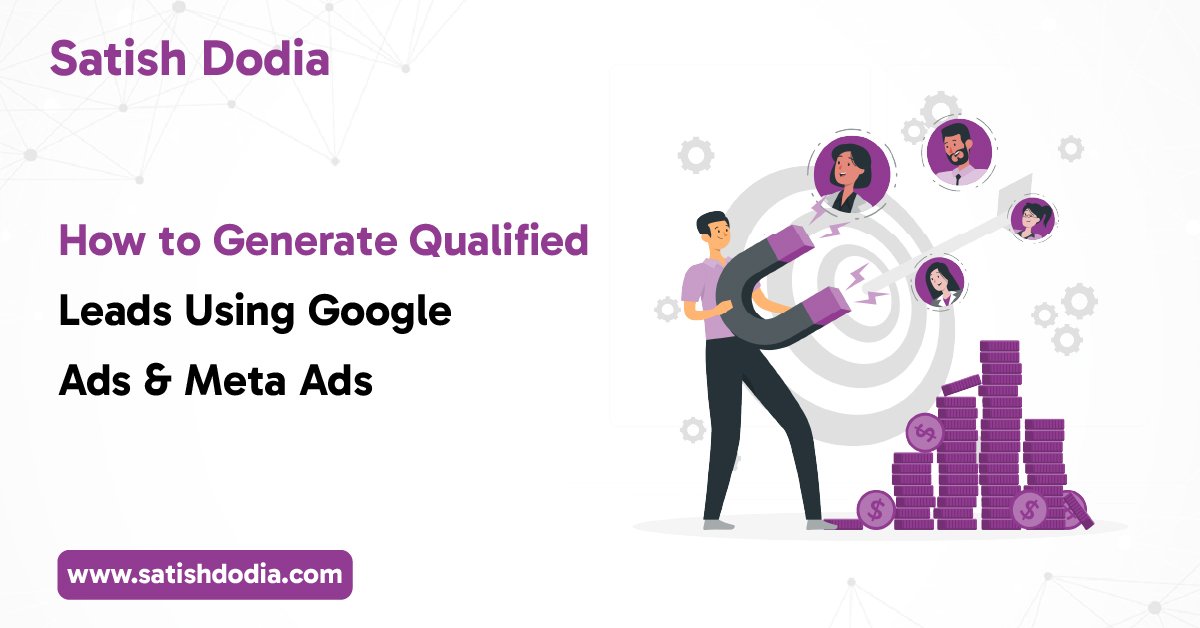

Generating thousands of website visitors is easy. Generating qualified leads that become paying customers is the real challenge.
In 2026, businesses can no longer rely on random advertising campaigns or broad audience targeting. Google’s AI-powered Search campaigns and Meta’s advanced machine learning have transformed digital advertising, making it possible to reach the right customer at exactly the right time.
However, success depends on strategy—not just budget.
Whether you’re a startup, local business, eCommerce brand, healthcare provider, or service-based company, understanding how to combine Google Ads and Meta Ads effectively can dramatically increase your return on investment.
As an experienced Performance Marketer, the goal isn’t just generating clicks—it’s generating measurable business growth.
Why Qualified Leads Matter More Than Traffic
Many businesses celebrate getting thousands of website visitors.
Unfortunately…
Traffic doesn’t pay the bills.
Qualified leads do.
Qualified leads are people who:
- Need your product or service
- Have buying intent
- Can afford your pricing
- Are ready to take action
- Match your ideal customer profile
A campaign generating 100 qualified leads is often more valuable than one generating 10,000 random visitors.
That’s why every successful Top Performance Marketer focuses on lead quality before lead quantity.
Understanding Google Ads vs Meta Ads
Although both platforms generate leads, they work differently.
| Google Ads | Meta Ads |
| Captures demand | Creates demand |
| Intent-based marketing | Interest-based marketing |
| Search driven | Discovery driven |
| High buying intent | Excellent brand awareness |
| Great for local businesses | Great for scaling audiences |
The best-performing businesses rarely choose one platform.
They combine both.
When Google Ads Works Best
Google Ads is ideal when customers are actively searching.
Examples include:
- Physiotherapist near me
- Digital marketing agency
- Emergency plumber
- Immigration consultant
- Shopify developer
- Personal trainer
- Dentist
- Business consultant
Search campaigns target users who already want a solution.
That means:
- Higher conversion rates
- Better lead quality
- Faster ROI
- Lower customer acquisition costs
When Meta Ads Deliver Better Results
Meta Ads (Facebook & Instagram) excel at discovering new customers before they search.
Perfect for:
- Fashion brands
- Beauty clinics
- Restaurants
- Home décor
- Fitness businesses
- Coaches
- Luxury products
- Real estate
- Educational courses
Meta’s AI finds people based on:
- Interests
- Behavior
- Purchase activity
- Demographics
- Engagement
- Website activity
This makes it ideal for building awareness while generating affordable leads.
Combining Google Ads & Meta Ads for Maximum ROI
Businesses often ask:
“Which platform is better?”
The answer is both.
A modern marketing funnel looks like this:
Step 1
Meta Ads introduce your brand.
Potential customers watch videos, engage with posts, or visit your website.
Step 2
Retarget visitors using Meta.
Show testimonials.
Success stories.
Offers.
Case studies.
Step 3
Capture high-intent searches using Google Ads.
When prospects search your business or service, your ad appears first.
Step 4
Optimize conversions.
Use landing pages, CRM automation, email follow-ups, and remarketing.
This creates multiple customer touchpoints, increasing trust and improving conversion rates.
Audience Targeting Strategies That Actually Work
One of the biggest reasons campaigns fail is poor targeting.
Successful advertisers build audiences using:
Custom Audiences
- Website visitors
- Previous customers
- Email subscribers
- CRM lists
Lookalike Audiences
Meta identifies users similar to your best customers.
These audiences often outperform broad targeting.
Search Intent
Google Ads lets advertisers target people searching specific keywords.
For example:
- Performance Marketer
- Google Ads Expert
- PPC Consultant
- Digital Marketing Consultant
- Meta Ads Specialist
These users already have purchase intent.
Geographic Targeting
Businesses should advertise only where they provide services.
Examples:
- City-specific campaigns
- Radius targeting
- Local service campaigns
Local optimization significantly improves conversion rates.
Landing Pages That Convert Visitors into Customers
Sending paid traffic to a homepage is one of the biggest advertising mistakes.
Instead, create dedicated landing pages with:
- Clear headline
- Strong value proposition
- Customer testimonials
- Trust badges
- Fast loading speed
- Mobile optimization
- Contact form
- Click-to-call button
- Clear CTA
Every extra second of loading time reduces conversions.
A high-converting landing page can double or even triple your advertising ROI.
AI & Automation Trends in Paid Advertising
Artificial Intelligence is changing advertising faster than ever.
Successful advertisers now leverage:
Performance Max Campaigns
Google automatically optimizes:
- Search
- Display
- YouTube
- Gmail
- Maps
- Discover
Using machine learning.
AI Audience Expansion
Meta identifies hidden customer segments that manual targeting often misses.
Smart Bidding
AI adjusts bids based on:
- Device
- Time
- User behavior
- Conversion likelihood
- Competition
This improves efficiency while lowering acquisition costs.
Predictive Analytics
Modern dashboards predict campaign performance before significant budget is spent, allowing faster optimization.
Common Mistakes Businesses Make
Avoid these costly errors:
Targeting Everyone
Broad targeting wastes budget.
Ignoring Conversion Tracking
Without accurate tracking, optimization becomes guesswork.
Weak Ad Copy
Benefits sell.
Features inform.
Focus on solving customer problems.
No Remarketing
Most visitors don’t convert on their first visit.
Remarketing recovers lost opportunities.
Slow Websites
Paid traffic should never land on slow pages.
Website speed directly impacts Quality Score and conversions.
Performance Metrics Every Business Should Track
Successful campaigns focus on business metrics—not vanity metrics.
Monitor:
- Cost Per Lead (CPL)
- Return on Ad Spend (ROAS)
- Cost Per Acquisition (CPA)
- Conversion Rate
- Click-Through Rate (CTR)
- Quality Score
- Customer Lifetime Value (CLV)
- Average Order Value (AOV)
- Lead-to-Sale Ratio
These KPIs reveal what is truly driving growth.
Why Working with a Performance Marketer Matters
Digital advertising is more competitive than ever.
Hiring a skilled Performance Marketer can help you:
- Reduce wasted ad spend
- Improve lead quality
- Increase conversions
- Scale profitable campaigns
- Build long-term growth strategies
- Optimize landing pages
- Improve analytics
- Track ROI accurately
A Top Performance Marketer understands how to combine creativity, data analysis, automation, and customer psychology to generate consistent business results.
For businesses looking to grow sustainably, working with an experienced professional like Satish Dodia means every advertising dollar is invested with measurable outcomes in mind.
Final Thoughts
Running ads is easy. Running profitable ads consistently requires strategy, testing, and continuous optimization.
The most successful businesses in 2026 don’t rely on a single platform. They build an integrated marketing system where Google Ads captures demand, Meta Ads creates demand, and optimized landing pages convert visitors into loyal customers.
By focusing on audience quality, data-driven decisions, AI-powered optimization, and conversion-focused experiences, businesses can generate qualified leads while maximizing every advertising dollar. Whether you’re a startup or an established brand, partnering with an experienced Performance Marketer can be the difference between spending on ads and investing in measurable growth.
Frequently Asked Questions (FAQs)
1. What is a Performance Marketer?
A Performance Marketer focuses on measurable marketing results such as leads, sales, conversions, and return on investment rather than vanity metrics like impressions or likes.
2. Which is better for lead generation: Google Ads or Meta Ads?
Google Ads captures users with high purchase intent, while Meta Ads helps create demand and build awareness. Using both together typically delivers the best results.
3. How can I reduce my Google Ads cost per lead?
Improve keyword targeting, optimize landing pages, use conversion tracking, test ad copy, and apply smart bidding strategies to improve efficiency.
4. How much budget should I start with?
The ideal budget depends on your industry and competition. Start with a manageable monthly budget, monitor performance, and increase spending on campaigns that consistently generate profitable leads.
5. Why aren’t my ads converting?
Common reasons include poor audience targeting, weak ad copy, slow landing pages, lack of trust signals, or missing conversion tracking.