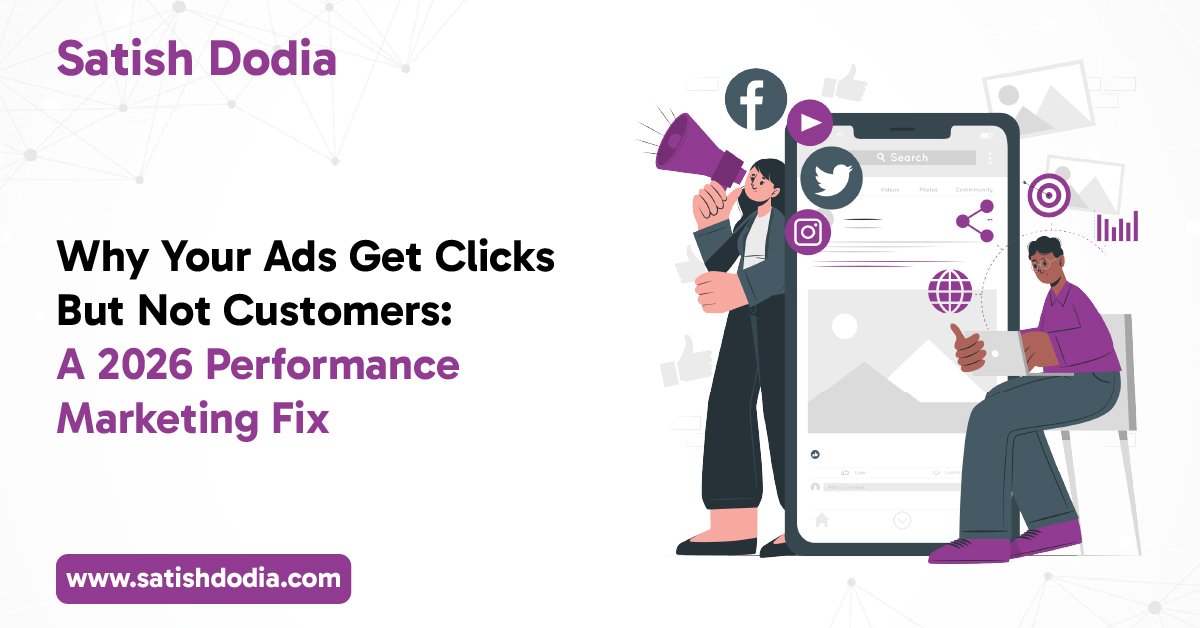

Your ad campaign is getting clicks. The dashboard looks active. Traffic is coming in.
But the phone is not ringing.
The enquiries are slow. Sales are inconsistent. And your advertising budget keeps disappearing.
This is one of the most frustrating problems businesses face with paid advertising.
The issue is not always the number of people clicking your ads. The bigger question is what happens after the click.
A successful campaign needs to connect the right audience with the right message, offer, landing page and follow-up process. If one part breaks, your clicks may never become customers.
Why More Ad Clicks Don’t Always Mean More Customers
Clicks are only one part of the customer journey.
Someone might click because your headline caught their attention. That does not necessarily mean they are ready to buy.
For example, imagine a company spending £2,000 on advertising and receiving hundreds of clicks. On paper, the campaign looks successful.
But if most visitors leave without enquiring, the business has paid for traffic rather than generating meaningful opportunities.
This is why performance should be judged further down the funnel.
Ask:
- Are visitors becoming leads?
- Are those leads relevant?
- How many leads become customers?
- What does each customer actually cost?
- Is the campaign producing profitable revenue?
The goal is not simply to make advertising platforms report impressive numbers. The goal is to create measurable business growth.
Clicks vs Leads vs Sales: What Really Matters?
It is easy to focus on clicks because they are visible and immediate.
However, a click has limited value on its own.
A better way to view the journey is:
Ad → Click → Landing Page → Enquiry → Qualified Lead → Customer → Revenue
Every stage can affect the final result.
A campaign with 1,000 clicks and five customers may be less valuable than one with 300 clicks and 20 customers.
That is why businesses should look beyond traffic.
Metrics such as conversion rate, cost per qualified lead, customer acquisition cost and return on ad spend can provide a clearer picture.
7 Reasons Your Ads Get Clicks but Fail to Convert
1. You Are Targeting the Wrong Audience
Even a brilliant advertisement will struggle if it reaches people who have little interest in your offer.
Broad targeting can sometimes generate cheap traffic. But cheap traffic is not always valuable traffic.
Look at who is actually converting.
Check their location, interests, search behaviour, demographics and buying intent. Then compare that information with your current targeting.
Your campaign should attract people who have a genuine reason to consider your product or service.
2. Your Offer Is Not Clear Enough
People should quickly understand what you offer and why it matters.
If an advertisement says something vague like “Take Your Business Further,” it may sound polished but provide little reason to click.
A stronger message explains the actual benefit.
For example:
“Book a Free Website Audit and Find 5 Conversion Issues”
The second message gives users a specific reason to take action.
Clarity often beats cleverness.
3. Your Ad and Landing Page Tell Different Stories
Imagine clicking an advertisement promising a free consultation and arriving on a homepage filled with unrelated information.
The user now has to search for the offer.
That friction can cost you conversions.
Your landing page should continue the message introduced in the advertisement.
The headline, offer, supporting copy and call to action should feel connected.
4. Your Landing Page Is Too Complicated
A landing page does not need to contain every detail about your company.
Too much information can make decisions harder.
Look at:
- Page loading speed
- Mobile experience
- Headline clarity
- Form length
- Trust signals
- Calls to action
- Relevant testimonials
- Pricing information where appropriate
Remove anything that does not help the visitor make the next decision.
5. Your Campaign Objective Is Wrong
Advertising platforms provide different campaign objectives for different outcomes.
A campaign designed for traffic is not necessarily designed to generate qualified leads.
If your business needs enquiries, your campaign structure and optimisation should support that goal.
Before launching, decide what the campaign is actually supposed to achieve.
6. Your Conversion Tracking Is Incomplete
Poor tracking can make a good campaign look bad.
If important actions are not being recorded, you may not know which campaigns, keywords or audiences are producing customers.
Track meaningful actions such as:
- Form submissions
- Phone calls
- Purchases
- Bookings
- Sign-ups
- Qualified enquiries
The more accurately you measure the customer journey, the better decisions you can make.
7. Your Lead Follow-Up Is Too Slow
Sometimes the advertising campaign is not the problem.
The problem happens after someone submits an enquiry.
A potential customer may contact several businesses at the same time. If your response arrives hours later, someone else may already have won the opportunity.
Advertising and sales should work together.
A fast, relevant follow-up can have a major impact on the value of every lead you generate.
Are You Measuring the Right Performance Marketing KPIs?
Not every number deserves equal attention.
Some metrics look impressive but provide limited business insight.
Cost Per Lead
This tells you how much you are spending to generate an enquiry.
But a cheap lead is not automatically a good lead.
Conversion Rate
This shows the percentage of visitors who complete your desired action.
A low conversion rate can indicate problems with targeting, messaging, the landing page or the offer.
Customer Acquisition Cost
This goes deeper than cost per lead.
It considers how much it costs to acquire an actual customer.
For many businesses, this is a more useful figure when evaluating growth.
ROAS
Return on ad spend compares the revenue generated with advertising expenditure.
However, revenue is not the same as profit.
A campaign can show strong revenue while margins remain poor.
Lead Quality
This metric is often overlooked.
Ten highly relevant enquiries can be more valuable than 100 people who were never likely to buy.
How Google Ads and Meta Ads Fit Into a Performance Strategy
Google Ads and Meta Ads can play different roles in the customer journey.
Google often captures existing demand.
Someone searches for a service because they already have a problem or requirement. A well-targeted campaign can place your business in front of them at that moment.
Meta can be useful for reaching audiences based on interests, behaviours and other targeting signals. It can also help businesses create demand through engaging creative content.
The best platform depends on your audience, offer, buying cycle and business model.
There is no universal platform that works equally well for every company.
The Role of AI in Performance Marketing in 2026
AI is changing how advertising campaigns are created, analysed and optimised.
It can help marketers identify patterns, generate creative variations, analyse data and automate parts of campaign management.
But automation does not remove the need for strategy.
AI can process information quickly. It still needs the right business goals, quality data and human judgement.
The strongest approach is not simply letting automation run everything.
It is using technology to make better decisions faster.
Why Creative Testing Can Matter More Than Increasing Your Ad Budget
When a campaign stops performing, the first reaction is often to increase the budget.
That may not solve the problem.
If the audience is seeing the same message repeatedly, performance can decline.
Testing different creative angles can reveal what actually connects with your audience.
You might test:
- Different headlines
- Customer pain points
- Benefits vs features
- Short-form video vs static images
- Different calls to action
- Different offers
Small improvements can compound over time.
How Landing Pages Can Make or Break Your Ad Campaign
Your advertisement earns attention.
Your landing page needs to turn that attention into action.
A strong landing page usually answers three questions quickly:
What is being offered?
Why should I care?
What should I do next?
Trust also matters.
Relevant reviews, clear contact information, useful proof and straightforward messaging can reduce hesitation.
Most importantly, check the page on mobile.
A campaign can lose potential customers if the mobile experience feels slow or difficult to use.
How to Reduce Wasted Ad Spend Without Killing Growth
Reducing waste does not mean stopping campaigns or choosing the cheapest clicks.
It means understanding where your money is going.
Start by reviewing:
- Which campaigns generate meaningful conversions?
- Which audiences produce qualified leads?
- Which search terms bring relevant visitors?
- Which advertisements have strong engagement?
- Which landing pages convert?
- Which leads become customers?
Then shift your attention towards what produces business value.
Performance marketing should be an ongoing process of testing, learning and improving.
Performance Marketing for London Businesses: What Should Be Different?
London is a competitive market.
Businesses are competing for attention across search engines, social platforms and local searches. This makes precision particularly important.
For companies targeting London customers, campaigns should consider factors such as location, service area, customer intent and local competition.
A campaign targeting all of London may not always make sense.
For some businesses, specific boroughs, neighbourhoods or customer segments may be more relevant.
A strong performance marketing London strategy should therefore begin with the customer, not simply the advertising platform.
Who are you trying to reach?
Where are they located?
What problem are they trying to solve?
What would make them choose your business?
Those answers should influence targeting, creative, landing pages and measurement.
A Simple Campaign Audit Before You Spend More
Before increasing your advertising budget, work through this checklist.
Audience: Are you reaching people who can realistically become customers?
Message: Does your advertisement communicate a clear benefit?
Offer: Is there a compelling reason to take action?
Landing page: Does the page match the advertisement?
Tracking: Are important conversions being recorded?
Lead quality: Are enquiries relevant to your business?
Follow-up: How quickly are new leads contacted?
Profitability: Are customers generating enough value to justify acquisition costs?
If several answers are unclear, increasing your budget may simply increase the amount of money being wasted.
When Should You Invest in Professional Performance Marketing Services?
Managing paid campaigns can look straightforward from the outside.
Create an advertisement. Choose an audience. Set a budget. Launch.
The reality is more complicated.
Campaign structure, tracking, creative testing, audience analysis, landing-page optimisation and ongoing decision-making all influence performance.
Professional support can be useful when your business is:
- Spending consistently but seeing weak returns
- Generating leads that rarely convert
- Struggling to understand campaign data
- Scaling advertising across multiple platforms
- Unsure where the budget is being wasted
- Ready to build a more measurable acquisition system
The right approach is not about spending more.
It is about understanding what is working, what is not and what should happen next.
Quick Reality Check: Is Your Campaign Actually Making Money?
Open your advertising dashboard and look beyond clicks.
Now ask yourself:
How much did we spend?
How many qualified leads did we generate?
How many became customers?
How much revenue came from those customers?
What did it actually cost to acquire them?
If you cannot answer these questions confidently, your next priority may be measurement rather than more advertising.
Frequently Asked Questions
1 Is performance marketing only about paid advertising?
No. Paid advertising is an important part of it, but performance marketing is broader. The focus is on measurable outcomes and improving the customer acquisition process.
2 How long does it take to improve an advertising campaign?
It depends on the business, budget, audience, conversion cycle and quality of existing data. Some issues can be identified quickly, while meaningful optimisation requires ongoing testing.
3 Should I increase my advertising budget if I am getting more clicks?
Not automatically. First check lead quality, conversion rates, customer acquisition cost and revenue. More traffic does not guarantee more customers.
4 Is Google Ads or Meta Ads better for generating leads?
Neither platform is universally better. The right choice depends on your audience, offer, buying intent and customer journey.
5 What should a business measure in performance marketing?
Focus on meaningful business metrics such as qualified leads, conversion rate, customer acquisition cost, revenue and return on ad spend.
Turn More Clicks Into Meaningful Business Results
Getting attention is only the beginning.
The real opportunity comes from connecting advertising, targeting, creative, landing pages, tracking and follow-up into one measurable system.
If your campaigns are generating clicks but not enough customers, the answer may not be another budget increase.
It may be a better strategy.
That is where an experienced performance marketer can help identify the gaps, test new opportunities and build campaigns around measurable business outcomes.