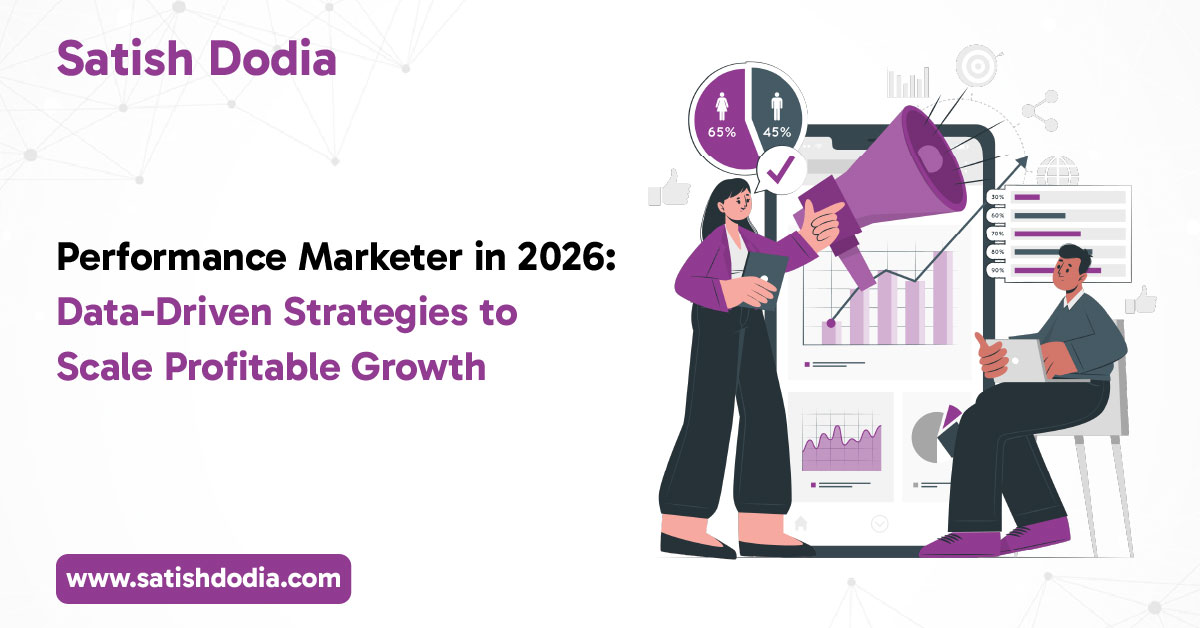

Introduction: Why Performance Marketing Is Dominating 2026
In 2026, businesses are no longer spending money on marketing just for visibility. They want measurable results. They want leads. They want sales. They want a return on investment.
This is exactly where a Performance Marketer comes in.
Unlike traditional digital marketing that focuses on impressions and reach, performance marketing focuses only on results — clicks, leads, conversions, and revenue. Every rupee spent is tracked. Every campaign is optimized. Every decision is based on data.
If you are a business owner, startup founder, or e-commerce brand, understanding how performance marketing works can completely change your growth trajectory.
In this guide, we will break down everything you need to know about performance marketing in 2026 and how it can help you scale profitably.
What is a Performance Marketer?
A Performance Marketer is a digital marketing expert who focuses only on measurable outcomes. Instead of running ads just for brand awareness, a performance marketer ensures that campaigns generate:
- Qualified leads
- Online sales
- App installs
- Website conversions
- Revenue growth
They specialize in paid advertising platforms and optimize campaigns daily to improve return on ad spend (ROAS).
Simply put:
Traditional marketers focus on visibility.
Performance marketers focus on profitability.
Performance Marketing vs Traditional Digital Marketing
Let’s understand the difference clearly.
| Traditional Digital Marketing | Performance Marketing |
| Focus on reach & impressions | Focus on conversions & revenue |
| Brand awareness campaigns | ROI-driven campaigns |
| Hard to measure results | Fully trackable |
| Long-term impact | Immediate measurable impact |
Performance marketing is transparent. You can see exactly where your money is going and what return you’re getting.
Why Performance Marketing is Growing Rapidly in 2026
There are three major reasons:
1. Businesses Want ROI
Companies don’t want “likes.” They want revenue.
2. Data is More Accessible
With advanced tracking tools, performance marketers can now measure:
- Customer journey
- Conversion rate
- Cost per acquisition
- Lifetime value
3. AI & Automation Tools
AI-powered tools now help optimize campaigns faster and better. But the strategy still requires a skilled performance marketer to guide it.
In 2026, marketing without data is simply gambling.
Core Skills of a Successful Performance Marketer
A true performance marketing expert must have multiple skills.
1. Paid Ads Expertise
- Google Ads
- Meta Ads
- YouTube Ads
- LinkedIn Ads
2. Conversion Rate Optimization (CRO)
Driving traffic is not enough. Landing pages must convert.
3. Data Analysis
Understanding numbers like:
- CTR
- CPC
- CPA
- ROAS
4. Funnel Strategy
Building structured sales funnels that guide users from awareness to purchase.
5. Retargeting Strategy
Most customers don’t buy on the first visit. Retargeting turns visitors into buyers.
Platforms Used by Performance Marketers
Here are the main advertising platforms used in 2026:
Google Ads
Best for high-intent buyers searching for products or services.
Meta Ads (Facebook & Instagram)
Powerful for targeting specific audiences and scaling e-commerce brands.
YouTube Advertising
Great for video storytelling and product demonstrations.
LinkedIn Ads
Ideal for B2B lead generation.
Each platform serves a different purpose in the sales funnel.
Data-Driven Strategies That Deliver Real ROI
A professional performance marketer never guesses. They test and optimize.
Here are proven strategies:
1. Audience Segmentation
Instead of targeting everyone, campaigns focus on:
- Custom audiences
- Lookalike audiences
- Interest-based targeting
2. A/B Testing
Testing different:
- Ad creatives
- Headlines
- Landing pages
- Offers
3. Budget Scaling Strategy
Scaling ads only when profitable metrics are achieved.
4. Conversion Tracking Setup
Using:
- Google Tag Manager
- Facebook Pixel
- Conversion APIs
Without tracking, performance marketing does not work.
Performance Marketing Funnel Explained
Every successful campaign follows a structured funnel.
Top of Funnel (Awareness)
- Video ads
- Brand introduction
- Educational content
Goal: Capture attention.
Middle of Funnel (Consideration)
- Retargeting ads
- Testimonials
- Case studies
Goal: Build trust.
Bottom of Funnel (Conversion)
- Limited-time offers
- Strong CTAs
- Discount campaigns
Goal: Drive sales.
A performance marketer designs ads for every stage.
How Performance Marketing Scales E-commerce Brands
E-commerce growth is directly connected to paid traffic.
Here’s how scaling works:
- Start with small test budget
- Identify winning creatives
- Analyze cost per purchase
- Optimize landing page
- Increase budget gradually
The key metric is ROAS (Return on Ad Spend).
For example:
If ₹1 lakh ad spend generates ₹4 lakh revenue → ROAS = 4x
That’s profitable scaling.
Common Mistakes Businesses Make Without a Performance Marketer
Many businesses waste money because:
- They boost posts instead of running structured campaigns
- They don’t track conversions
- They target broad audiences
- They ignore retargeting
- They scale too quickly without data
Paid ads are powerful — but only when managed correctly.
Real Growth Framework Used by Top Performance Marketers
Here is a simplified framework:
Step 1: Market Research
Understanding competitors and customer behavior.
Step 2: Funnel Planning
Mapping awareness to conversion journey.
Step 3: Campaign Structure
Separate campaigns for:
- Cold audience
- Warm audience
- Hot audience
Step 4: Daily Optimization
- Kill underperforming ads
- Scale profitable ads
- Test new creatives
Step 5: Data Reporting
Weekly analysis of:
- Cost per lead
- Cost per sale
- Conversion rate
- ROAS
This structured approach ensures predictable growth.
Why Hiring a Performance Marketer is a Smart Investment
Some businesses think running ads is easy.
Yes, launching ads is easy.
Making them profitable is not.
A skilled performance marketer can:
- Reduce cost per acquisition
- Improve conversion rate
- Increase average order value
- Scale revenue without increasing risk
Instead of spending randomly, you invest strategically.
FAQ – Performance Marketer
Q1. What does a performance marketer do?
A performance marketer runs paid advertising campaigns focused on measurable results like leads, sales, and revenue.
Q2. Is performance marketing better than digital marketing?
Performance marketing is a type of digital marketing focused only on ROI and measurable outcomes.
Q3. How much does it cost to hire a performance marketer?
Costs vary depending on experience, industry, and ad budget size.
Q4. Can performance marketing work for small businesses?
Yes. With the right strategy, even small budgets can generate leads and sales.
Q5. What industries benefit most from performance marketing?
E-commerce, real estate, education, healthcare, SaaS, and service-based businesses benefit the most.
Final Thoughts
Performance marketing is no longer optional in 2026. It is essential.
Businesses that rely only on organic marketing grow slowly. Businesses that combine organic growth with structured paid performance campaigns grow faster and more predictably.
If your goal is measurable growth, scalable revenue, and controlled ad spend, hiring a skilled Performance Marketer is one of the smartest decisions you can make.
The future of marketing is not about visibility.